If a scammer gets hold of your banking app or OTPs, the first few minutes decide how much money you lose. On 23 November 2026 the Reserve Bank of India released draft rules that would give account holders an emergency Stop Switch, their own limits on every payment channel, and an optional trusted person who must approve big transfers. These are proposals, not live features. Here is how each one would work, with a worked ₹ example, the dates that matter, and how you can send RBI your own feedback before 14 December.
What RBI has proposed, in one table
The details below come from the draft text RBI published for payments banks (Payments Banks – Responsible Business Conduct Third Amendment Directions, 2026). The press release says matching drafts were issued for commercial banks, small finance banks, regional rural banks, local area banks and urban and rural co-operative banks.
| Proposal | What it would do | What it would not do |
|---|---|---|
| Stop Switch | Immediately blocks all customer-initiated outward debits, new mandates, new standing instructions and UPI registration on new third-party apps | Does not stop incoming credits, existing recurring mandates, or bank debits such as loan EMIs and charges |
| Channel-wise controls | Lets you disable a channel, or set per-transaction, per-beneficiary, daily and all-channel limits, plus time windows when a channel stays off | Cannot raise limits above what the bank or payment system already allows |
| Card controls | Switch domestic/international, ATM, PoS, online and contactless use on or off, and set limits | Not applicable to gift and transit prepaid cards |
| Trusted Person Mechanism (TPM) | A person you nominate must approve fund transfers above your chosen threshold within one hour | Does not cover UPI, merchant payments or recurring mandates; the trusted person gets no access to your balance or account |
| Safer defaults | Digital channels off by default for new customers; new cards work only at ATMs and PoS within India until you change it; a 24-hour cap on transfers after a channel is first switched on | Existing customers keep their current settings unless they change them |
How the Stop Switch would work
Think of it as a panic button for your account. Once you activate it, the draft says no customer-initiated debit can go out, and no new payment mandate, standing instruction or UPI registration on a new third-party app is allowed. Money can still come in. Banks must offer the switch through branches, ATMs, internet banking, mobile banking and IVR, and must alert you by SMS and email every time it is turned on or off.
Turning it off is deliberately harder. The bank must authenticate you at least as strictly as when the channel was first enabled, and may add a “reasonable cooling period” before payments resume. That delay is the point: a fraudster who has taken over your phone should not be able to flip the switch back in seconds.
How the trusted person approval would work
The TPM is voluntary. You register someone, for example a son, daughter or spouse, by giving the bank their name, a different mobile number from yours, an email address and one officially valid document. The bank verifies them, and the feature goes live only after a 24-hour cooling period. Changing the person, the threshold or the channels, or opting out, also waits 24 hours.
When a transfer crosses your threshold, the trusted person gets the amount, the beneficiary’s name and account or mobile number, and your narration. They have one hour to approve. A “no”, or silence, means the transfer is rejected. RBI’s draft is explicit that the trusted person is not a joint holder, nominee or signatory, cannot start transactions, cannot see your balance, deposits or investments, and carries no financial liability for approving or rejecting.
Worked ₹ example
Suppose a retired customer sets a TPM threshold of ₹50,000 and names her daughter as trusted person. She also uses the channel controls to cap UPI at ₹25,000 a day, since UPI is outside the TPM.
- A caller posing as a bank official convinces her to send ₹1,80,000 by NEFT to a “safe account”. Because ₹1,80,000 is above ₹50,000, the daughter gets an alert showing an unknown beneficiary. She rejects it, or simply does not respond within an hour, and the money stays put.
- The caller then pushes her to pay by UPI instead. The ₹25,000 daily UPI cap means the most that can leave that way in a day is ₹25,000, not the full ₹1,80,000.
- Her ₹12,000 monthly SIP mandate and her loan EMI keep running, because recurring mandates are outside both the TPM and the Stop Switch.
The illustrative limits RBI itself uses in the draft are similar: ₹20,000 a day to one beneficiary, ₹10,000 per transaction on a channel, or ₹50,000 a day across a channel.
Key dates
| Date | What happens |
|---|---|
| 23 Nov 2026 | RBI publishes draft directions for public comment |
| 14 Dec 2026 | Last date for comments from banks and the public |
| 1 Jan 2027 | Proposed start of most of the wider “negligence by a bank” definition |
| 1 Jul 2027 | Proposed start of Stop Switch, customer controls and TPM (banks may start earlier) |
The wider negligence definition matters if you are ever defrauded. Under the draft, a bank would count as negligent if it fails to send mandatory transaction alerts, does not provide 24×7 fraud-reporting channels, or does not act promptly on your fraud report, among other lapses. That builds on the June 2026 customer-liability rules RBI mentions in its press release.
One more detail from Business Standard’s report: the draft follows RBI’s 9 April discussion paper, but it drops two ideas floated then, a one-hour delay on certain high-value payments and an annual credit ceiling with credits held in “shadow mode”.
How to send your feedback to RBI (steps)
- Read the draft for your bank type from the links in the RBI press release.
- Note specific points, for example whether one hour is long enough for a trusted person, or whether UPI should be included in the TPM.
- Submit through the “Connect 2 Regulate” link next to the document on RBI’s website, or email mcsdorfeedback@rbi.org.in.
- If emailing, use the subject line “Feedback on” followed by the full name of the draft, including the bank type, as RBI asks.
- Send it on or before 14 December 2026.
What you can do today, before any of this is live
- Open your bank app and switch off international and contactless card use if you do not need them.
- Lower the default UPI and net-banking limits to what you actually spend.
- Keep alerts on for both SMS and email, and check that your registered mobile number is current.
- If money leaves your account fraudulently, report it to your bank at once and call the national cybercrime helpline 1930. Speed matters for both recovery and liability.
For other banking situations, see our guides on what to do during the IDBI Bank strike and fighting a rejected health insurance claim, and our explainer on EPFO’s plan for direct PF deposits.
What banks have said
At the time of publishing, we did not find a public statement on the draft from the Indian Banks’ Association or individual large banks. Coverage by Business Standard and Mint stresses that the safeguards are not operational until RBI finalises them and banks implement them. We will update this post if banks or RBI respond.
FAQ
Is the RBI Stop Switch available now?
No. It is a draft. If finalised, it is proposed to apply from 1 July 2027, or earlier if a bank chooses.
Will the Stop Switch freeze my salary credits?
No. The draft says incoming credits are not affected.
Does the trusted person approve my UPI payments?
No. UPI, merchant payments and recurring mandates are excluded from the TPM. Use the channel limits for UPI instead.
Can the trusted person see my bank balance?
No. The draft bars banks from showing them your balance, deposits, investments or insurance details.
What if my trusted person does not respond?
The transfer is rejected after the one-hour window.
Sources: RBI press release, 23 Nov 2026; RBI draft directions (payments banks); Mint, 23 Nov 2026; Business Standard. This article is for information only and is not financial advice.
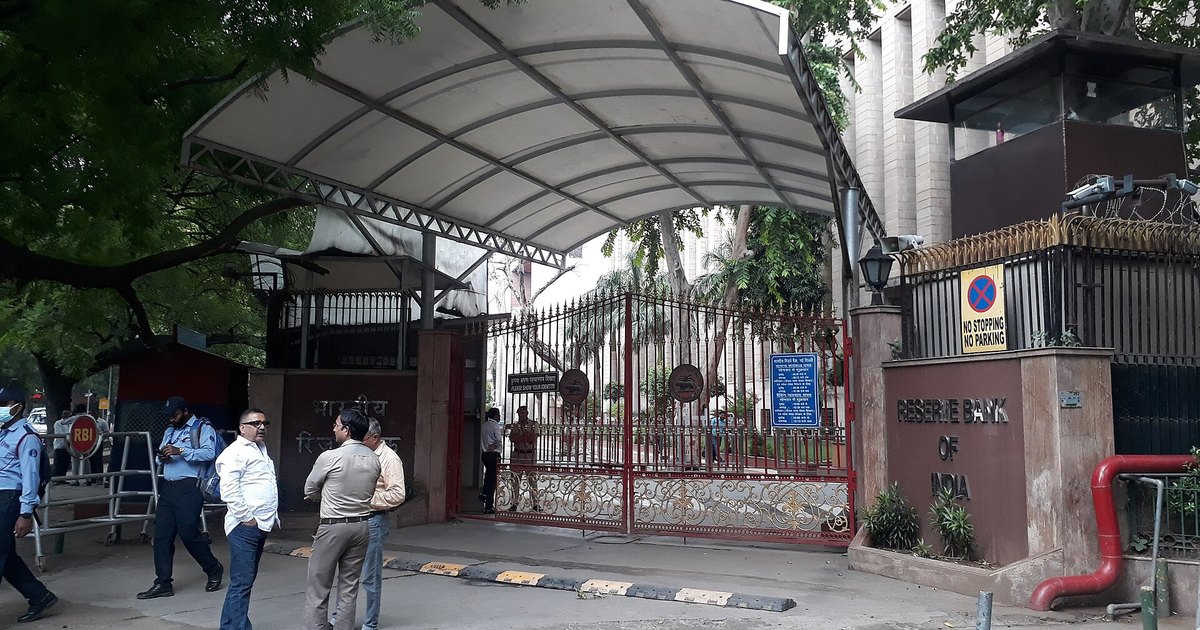
Featured image: Reserve Bank of India office on Sansad Marg, New Delhi. Photo: Pinakpani, Wikimedia Commons, CC BY-SA 4.0; cropped.