Until now, money has reached your provident fund account one way only: through your employer’s payroll. On 19 November 2026, EPFO’s Central Board of Trustees (CBT) approved a proposal that would change that. Members would be able to put money into their EPF account directly, linked to their UAN, and other people could send small “micro-contributions” such as customer tips into it.
The idea is trending today after an Upstox explainer asked the question many salaried people and gig workers have: can I simply top up my PF myself? The short answer is not yet. Here is what has been approved, what still has to happen, and how to think about it before the facility goes live.
What exactly did EPFO approve?
The PIB release on the 240th CBT meeting, chaired by Labour Minister Mansukh Mandaviya, says the Systematic Withdrawal Plan proposal “also introduces UAN-linked mechanisms for direct voluntary contributions and third-party micro-contributions (such as customer tips), completely independent of traditional employer payroll systems.”
Two separate ideas sit inside that sentence:
- Direct voluntary contributions: you deposit extra money into your own EPF account without going through your employer.
- Third-party micro-contributions: someone else, such as a customer tipping a delivery rider, could send a small amount into a worker’s UAN-linked account.
According to Business Standard, people who make such third-party payments would not take on the status or liabilities of an employer, and EPFO would keep separate digital records of them. An official quoted by The Indian Express said direct contributions would not need employer matching and would be credited straight to the member’s PF account, “subject to limits prescribed under the Income-tax Act and those decided by the CBT”.
Is it live? Not yet. Here is the timeline
| Stage | Status (as of 23 Nov 2026) | Source |
|---|---|---|
| CBT approval of the proposal | Done, 19 Nov 2026 | PIB |
| Labour Ministry approval and EPF Scheme amendment | Pending; “will be notified accordingly after approval from the Ministry” | PIB |
| Legal vetting by Department of Legal Affairs | Pending | Business Standard |
| Income Tax Act amendment for tax treatment | Being “taken up with the Ministry of Finance” | PIB |
| Extension to unorganised workers (construction, domestic, street vendors, home-based) | Later stage; needs a separate decision under the Code on Social Security, 2020 | Business Standard |
No launch date has been given. Upstox notes that until the scheme amendment is notified, contributions continue to flow the old way, through the employer.
Can’t I already put extra money in PF through VPF?
Yes, but only through your employer. Upstox points to Paragraph 19 of the EPF Scheme, which lets a member make an additional voluntary contribution, with the employer transferring it to EPFO through the Electronic Challan-cum-Return (ECR). The new route would remove that dependence. That matters most for three groups:
- People between jobs, whose accounts get no fresh money while they are not on a payroll.
- Self-employed people and freelancers who once had a PF account and want to keep using it. The Economic Times described the decision as paving the way for self-employed people to contribute “independent of any employer-employee relationship”.
- Gig and platform workers such as delivery riders and drivers, whose tips could flow into retirement savings.
Worked example: what small monthly top-ups could grow to
EPF earned 8.25% for 2025-26, the rate cited by Upstox. The table below is an illustration only. It assumes that rate stays the same every year, that interest is worked out monthly on the running balance and added once a year, and that no withdrawals are made. Actual rates are declared every year and will vary.
| Monthly top-up | You put in (10 years) | Approx. balance after 10 years | Approx. balance after 20 years |
|---|---|---|---|
| ₹500 | ₹60,000 | ₹91,900 | ₹2.95 lakh |
| ₹1,000 | ₹1.2 lakh | ₹1.84 lakh | ₹5.90 lakh |
| ₹1,250 (e.g. ₹50 a day in tips for 25 days) | ₹1.5 lakh | ₹2.30 lakh | ₹7.37 lakh |
| ₹2,000 | ₹2.4 lakh | ₹3.68 lakh | ₹11.8 lakh |
Calculation by 2px. The figures are pre-tax because the tax treatment of direct contributions has not been decided.
The open questions you should watch
Upstox lists several details the release does not settle. Keep these in mind before you plan around the facility:
- Tax: it is unclear whether direct deposits will get the same deduction and tax-free interest as payroll contributions.
- Caps: no limit on how much you can deposit has been announced.
- Employer match: the release does not say whether an employer may match it, though the Indian Express official said matching would not be required.
- Charges: no word yet on administrative charges.
- Payment channel: how a tip would be verified and credited to a UAN has not been explained. Business Standard says it will need integration with banking and digital payment networks.
- Exempted trusts: the Indian Express says the scheme is limited to members of EPFO’s statutory fund, not employees whose PF is run by an exempted company trust.
Liquidity got better too
A direct-deposit option is more useful if you can get the money back when you need it. The same CBT meeting cut the minimum balance a member must keep from 25% to 10% of contributions, and the waiting period for final withdrawal after leaving a job from 12 months to two months (PIB, ET). We explained the withdrawal side in our guide to EPFO’s Systematic Withdrawal Plan and monthly PF payouts.
Checklist: get your PF account ready now
Whenever the facility arrives, it will be UAN-linked. These steps are worth doing today whatever happens:
- Find your UAN on your payslip or on the EPFO member portal, and make sure it is activated.
- Check that your Aadhaar, PAN and bank account are seeded (KYC approved) on the portal.
- If you have several old PF accounts, transfer them into one so that a direct deposit lands in the right place.
- Update your nomination (e-nomination) on the portal.
- Download your passbook and check that past employer deposits have been credited.
- Do not pay anyone who claims they can open “direct PF deposits” early. Until EPFO notifies the scheme, there is no such official channel.
Should you wait for this or use PPF or VPF?
If you are salaried and want to save more in a fixed-income product today, VPF through your employer works now. PPF is open to anyone through a bank or post office. The new EPFO route matters most for people who have no employer to route money through. Until its tax treatment is clear, do not move money you need for near-term goals. If medical costs are your worry, our step-by-step guide on what to do when a health insurance claim is rejected is also worth bookmarking. For market-linked savings, see our note on checking your US fund exposure after the Nasdaq fall.
FAQ
Can I deposit money in my PF account without my employer today?
No. The CBT has only approved the proposal. The EPF Scheme amendment and the tax change still have to be notified.
Will direct PF deposits get tax benefits?
That is undecided. PIB says a matching amendment to the Income Tax Act is being taken up with the Finance Ministry.
Who can send micro-contributions?
The release gives customer tips as the example. Business Standard reports that tips, gifts and gratuities into UAN-linked accounts are covered, and that the people paying them would not become employers.
Do gig workers need a UAN to benefit?
The mechanism is described as UAN-linked. How workers without an existing PF account would join has not been spelled out, and Business Standard says extending it to unorganised workers needs a separate government decision.
What interest would the money earn?
The same EPF rate that applies to the account, assuming the final rules say so. That rate was 8.25% for 2025-26 and is declared each year.
Sources: PIB, 240th CBT meeting (19 Nov 2026); Upstox (23 Nov 2026); Business Standard; The Indian Express; The Economic Times.
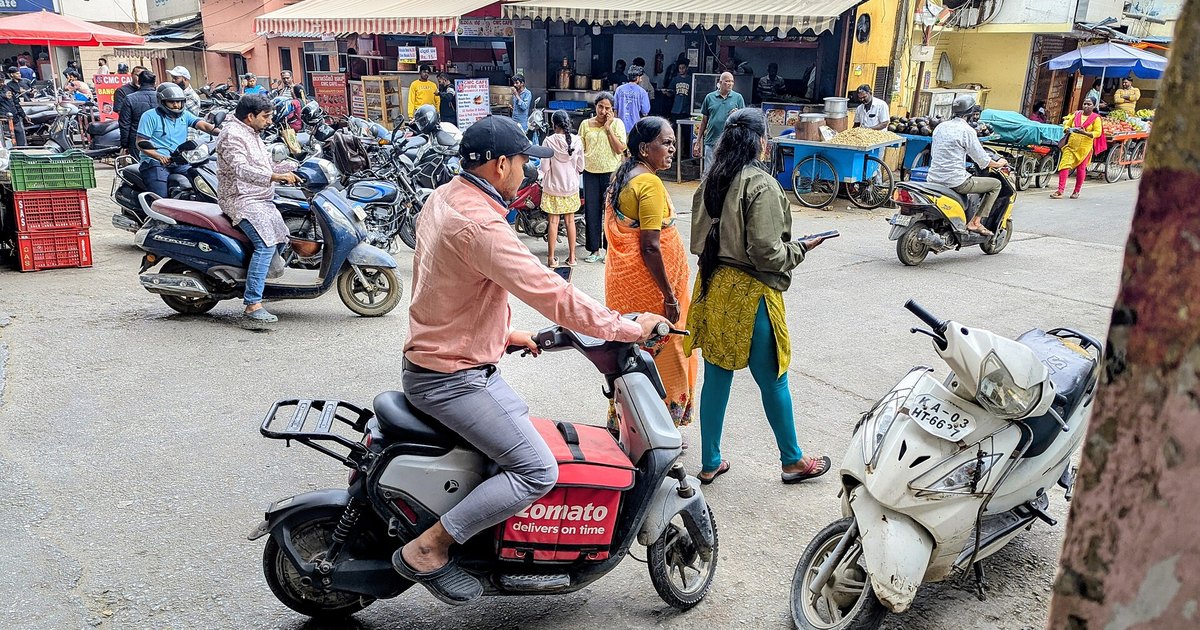
Featured image: Zomato delivery partner on a Yulu bike, Bengaluru, by SerChevalerie, Wikimedia Commons, CC0; cropped. Used as a representative image of gig work.