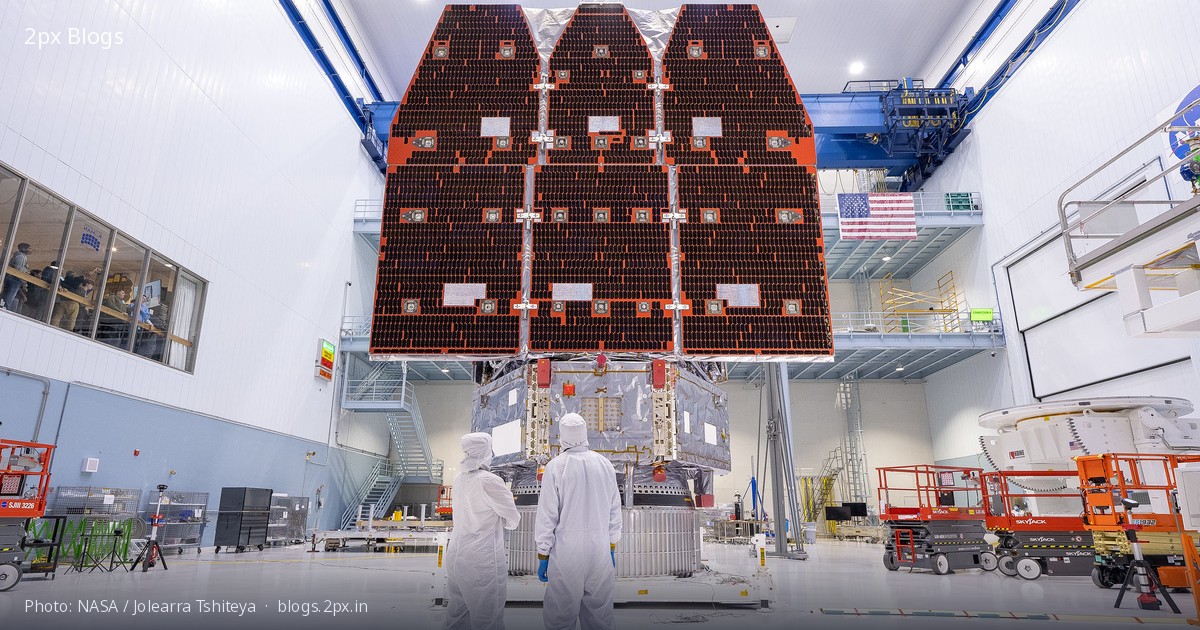
NASA has set a date for the first public look at the universe through its newest flagship observatory. On Monday, December 7, 2026, at 3:30 p.m. Eastern Time (12:30 p.m. Pacific, which is 2:00 a.m. IST on December 8), the agency will unveil the first images from the Nancy Grace Roman Space Telescope during a livestream from the American Geophysical Union’s annual meeting in San Francisco.
The pictures will also go up on NASA’s website at the same time. You do not need a press pass. NASA says the public broadcast will run on nasa.gov/live and on the agency’s usual social channels, as well as AGU’s.
This is not a science-result announcement in the usual sense. No one outside the team has seen these images yet. What December 7 can show is whether Roman’s wide, sharp infrared camera is working as designed — and it gives the rest of us a first chance to understand why this telescope is different from Hubble and Webb. It also arrives just weeks after Voyager 1 reached one light-day from Earth, a useful pairing: one mission looking back at a spacecraft leaving the Sun’s neighborhood, another opening a much wider window on the distant universe.
When and How to Watch
According to NASA’s November 17 media advisory, the day unfolds in three public-facing steps, all in Eastern Time:
- 12:00 p.m., December 7: an embargoed preview for journalists at the AGU meeting. Media have to be registered with AGU by 8:00 p.m. on Sunday, December 6. After the briefing, NASA plans embargoed interviews for registered reporters. A recording is due on the AGU site once the embargo lifts at 3:30 p.m.
- 2:45 p.m.: NASA Administrator Jared Isaacman joins a fireside conversation, moderated by science journalist Alex Witze, about the links between Earth science and space science.
- 3:30 p.m.: the public livestream of the first images, on NASA and AGU channels, with the pictures posted on the agency’s site at the same moment.
On Tuesday, December 8, from 6:00 a.m. to 1:00 p.m. Eastern, Roman mission experts will be available for live remote interviews with broadcast media. If you just want to watch, the Monday 3:30 p.m. Eastern slot is the one that matters. Set a reminder now. First-image events have a habit of slipping past people who meant to “catch it later” and then ran into spoilers instead of the official feed.
Why Roman Is Not “the Next Hubble”
NASA is careful about this point. On its Hubble vs. Roman explainer, the agency says Roman is not a successor to Hubble or to the James Webb Space Telescope. It joins them. Hubble can still deliver detailed views in ultraviolet, visible, and near-infrared light. Webb specializes in a deeper infrared look at chosen targets. Roman’s job is to take panoramic views of large patches of sky, then hand the most interesting objects to the zoom lenses.
The hardware that makes that possible is the Wide Field Instrument, a 300-megapixel infrared camera. NASA’s WFI page says each Roman image will cover a patch of sky bigger than the full Moon appears in the sky. Hubble’s infrared pictures from Wide Field Camera 3 are about 200 times smaller. Even Hubble’s widest exposures, from the Advanced Camera for Surveys, are nearly 100 times smaller. Over its first five years, Roman is expected to image more than 50 times as much sky as Hubble covered in its first 30 years, and to survey the sky up to 1,000 times faster, with similar sensitivity and infrared resolution.
The telescope’s primary mirror is 2.4 meters across, the same class of size as Hubble’s. The difference is the field of view. NASA’s Adopt a Pixel page puts it simply: the Wide Field Instrument gives Roman a field of view 100 times greater than Hubble’s infrared instrument, so it can capture more sky in less observing time. Eighteen detectors sit at the heart of the camera, turning incoming starlight into the large, high-resolution frames scientists will spend the next decade sorting through.
The science goals are the ones Roman was built to attack: dark energy, dark matter, and planets around other stars. Dark energy is the poorly understood influence that appears to be speeding up the universe’s expansion. Dark matter does not emit light we can see, but Roman can watch how visible galaxies and clusters move under its gravity. For exoplanets, Roman will use more than one method, including a Coronagraph Instrument — a set of masks, prisms, detectors, and flexible mirrors designed to block a star’s glare and reveal planets orbiting it.
From the Clean Room to Lagrange Point 2
Roman launched on August 30, 2026, from NASA’s Kennedy Space Center in Florida on a SpaceX Falcon Heavy rocket. NASA describes a three-month, million-mile trip to its working orbit at the Sun-Earth Lagrange Point 2, a gravitationally convenient spot about a million miles from Earth. During the cruise, teams have been commissioning the observatory: turning systems on, adjusting them, calibrating them, and preparing them to do science. The December 7 images are the public proof of that work.
The mission is named for Nancy Grace Roman, NASA’s first chief of astronomy and a central figure in the campaign that led to Hubble. It is managed at NASA’s Goddard Space Flight Center in Greenbelt, Maryland, with partners including JPL, Caltech/IPAC, the Space Telescope Science Institute, and industrial contractors BAE Systems, L3Harris, and Teledyne.
You Can Claim a Pixel
NASA is inviting the public to “adopt” a pixel from one of the first images. After the pictures are revealed, you can look up a personal pixel and receive a digital trading card — NASA also describes a printable certificate — with information about that tiny piece of the sky. The Adopt a Pixel page says only one pixel can be assigned per email address. If several people in a family share one inbox, they will share a pixel too. Registration is at the mission’s Adopt a Pixel site, linked above.
That is a small, human hook on a very large instrument, and it is a good one to share with children or classrooms. The images themselves will be scientific engineering products first, beautiful second. They are still worth watching live. First light, even when it is carefully staged, is one of the few moments when a space telescope feels like a public event rather than a paper in a journal.
If you want a still wider sense of how far human hardware now reaches, pair the livestream with the Voyager 1 light-day milestone. One spacecraft is a relic of the 1970s talking to Earth with a day’s delay. The other is a new observatory at L2, about to show us more sky at once than Hubble ever could. Both are NASA missions. They just live at opposite ends of the same idea: go out there, and send something back.
Frequently Asked Questions
When are the Roman Space Telescope’s first images being released?
Monday, December 7, 2026, at 3:30 p.m. EST (12:30 p.m. PST, 2:00 a.m. IST on December 8), in a NASA livestream from the AGU meeting in San Francisco. The images will also be posted on NASA’s website.
Where can I watch?
NASA says the unveiling will stream at nasa.gov/live and on other NASA and AGU platforms. No special registration is required for the public broadcast.
How is Roman different from Hubble and Webb?
Roman is a wide-field infrared survey telescope. Hubble and Webb take deeper, narrower looks at chosen targets. Roman’s Wide Field Instrument covers a patch of sky larger than the full Moon in a single image, so it can map much more of the sky, much faster.
What is Adopt a Pixel?
It is a NASA public program that lets you claim one pixel from a selected first image and receive a digital card or certificate about that spot in the cosmos, with a limit of one pixel per email address.
Sources: NASA media advisory, Nov. 17, 2026; NASA — Wide Field Instrument; NASA — Hubble vs. Roman; NASA — Adopt a Pixel.