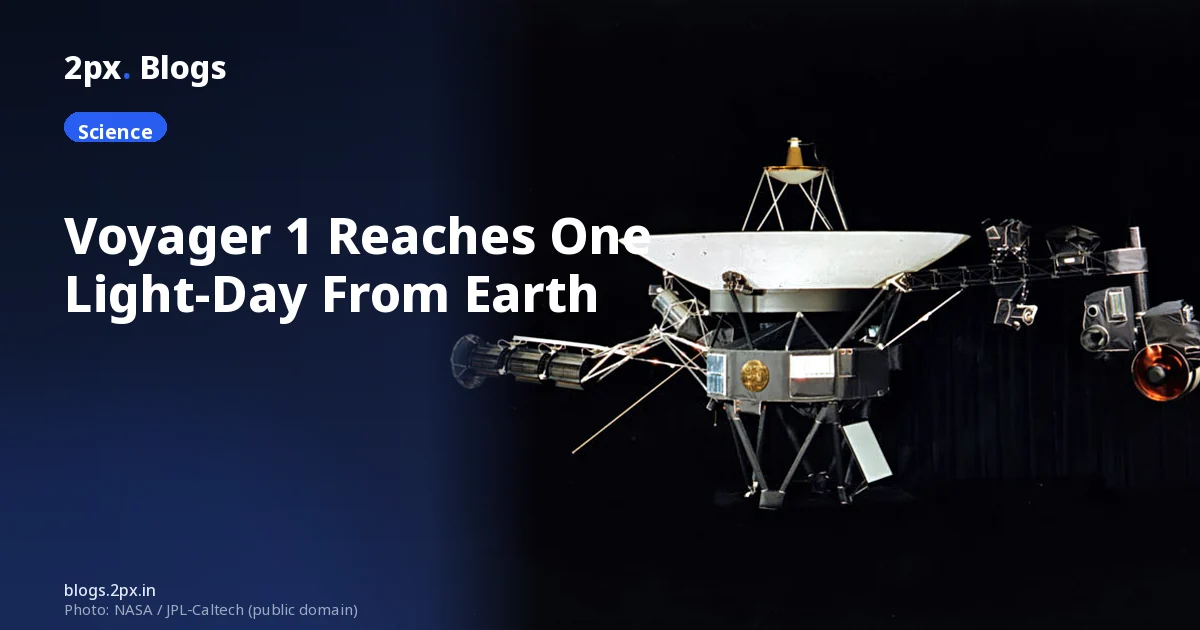
At 5:16:07 a.m. Eastern Standard Time on Wednesday, November 18, 2026, NASA’s Voyager 1 crossed a line no human-made object had ever reached. The spacecraft, launched in 1977 and still in contact with Earth, arrived at a distance of one light-day — the span light itself covers in 24 hours, about 16 billion miles (about 26 billion kilometers).
A radio command leaving Earth today will not reach Voyager 1 until tomorrow. If the spacecraft answers immediately, its reply will not arrive until the day after that. The mission has entered a conversation that takes two full days, even at the speed of light.
What Is a Light-Day?
A light-day is a measurement of distance, not time. Nothing in the universe travels faster than light, which moves through space at about 186,000 miles (299,000 kilometers) per second. In 24 hours, NASA says, that adds up to 16,094,799,096 miles, or 25,902,068,356 kilometers. When engineers say Voyager 1 is one light-day away, they mean a radio signal traveling at that speed limit now needs a full day to get there.
Light-seconds, light-minutes, and light-years
NASA uses light-travel times because ordinary miles quickly become unmanageable. The Moon is 238,855 miles (384,400 kilometers) from Earth, on average, and light covers that gap in 1.3 seconds. Sunlight takes about eight minutes and 20 seconds to travel the 93 million miles (about 150 million kilometers) from the Sun to Earth, so our star is about 8.3 light-minutes away. Neptune averages about 2.8 billion miles (4.5 billion kilometers) from Earth — four light-hours and 10 light-minutes away. A light-year is about 5.88 trillion miles (9.46 trillion kilometers). One light-day is only a first step on that scale, but it is a first step no spacecraft had taken until today.
How Far Is Voyager 1 From Earth?
On November 18, Voyager 1 reached about 16.09 billion miles from Earth, a distance EarthSky also gives as 173.14 astronomical units (AU). The spacecraft is cruising at nearly 38,000 mph (61,000 kph). Even at that speed, it took 49 years, two months, and 11 days to travel one light-day. Light covers the same stretch before a calendar day is over. If you could point a telescope at the probe, the light you would see would have left 24 hours earlier — a view of Voyager 1 a full day in the past.
Why Radio Messages Now Take a Full Day
NASA notes that a radio signal takes an entire day to reach Voyager 1 now. In a media briefing, the agency said the Voyager team will not receive the spacecraft’s “return call” from the light-day mark until the same time on November 19. Engineers at NASA’s Jet Propulsion Laboratory cannot troubleshoot in real time.
Deputy project scientist Jamie Rankin told NASA’s Curious Universe podcast that the distance is “a tangible distance that people can relate to.” It is remarkable, she said, not only that a human-made object is this far away, but that it “can send us a signal back — it can talk to us.” NASA’s Eyes on the Solar System tool lets anyone watch how long a signal takes to make the trip.
How Voyager 1 Got This Far
Voyager 1 launched on September 5, 1977, after Voyager 2 lifted off on August 20. It flew past Jupiter and Saturn, then steered toward interstellar space in 1980, becoming the first spacecraft to enter that region in August 2012 — outside the Sun’s bubble of particles and magnetic fields. Voyager 2 took a longer “Grand Tour,” becoming the first and, so far, only spacecraft to visit Uranus and Neptune. EarthSky reports it is about 2 billion miles (3.2 billion kilometers) closer to Earth and moving a bit slower on a different path. NASA says Voyager 2 is on pace to reach one light-day from Earth in November 2035.
Discoveries along the way
NASA credits Voyager 1 with transforming our view of the outer planets. It discovered active volcanoes on Jupiter’s moon Io — the first live eruptions ever witnessed on another world — and showed Jupiter’s Great Red Spot to be a massive, rotating, high-pressure storm. At Saturn, it measured the planet’s atmosphere and found that the rings are not uniform sheets. In 1977, it captured a crescent Earth and Moon together, the first such picture taken by a spacecraft. Years later, from beyond Neptune’s orbit, it took the first “family portrait” of the solar system. One frame became the famous Pale Blue Dot image: Earth as a solitary pixel in a beam of sunlight.
The Golden Record and a Message for the Stars
Both Voyagers carry a golden record etched with sounds and images from Earth. NASA says the probes will drift through the Milky Way galaxy forever. As quoted by EarthSky, Carl Sagan said the record would be played “only if there are advanced space-faring civilizations in interstellar space, but the launching of this ‘bottle’ into the cosmic ‘ocean’ says something very hopeful about life on this planet.” Voyager 1 is headed toward a star more than 17 light-years away, AC +79 3888, also known as Gliese 445, in Ursa Minor. NASA says it is expected to pass within about 1.7 light-years of that star — in 40,000 years.
Is Voyager 1 Still Working?
Yes. After nearly 50 years, both Voyagers are still operating and sending data back to Earth. Many science instruments have been turned off to conserve power, but the probes continue to return measurements from interstellar space. EarthSky reports that in April 2026, NASA turned off Voyager 1’s Low-Energy Charged Particle instrument; the agency could still switch it back on later. The mission will mark 50 years of exploration in 2027.
How People Marked the Milestone
NASA invited people around the world to join “Shine Bright for Voyager’s Light-Day” after sunset on November 17, pointing a flashlight, phone, or glow stick toward the sky and flashing V-G-R — Voyager’s call sign — in Morse code. The Planetary Society also planned a free livestream with Voyager project manager Suzanne Dodd, mission manager Kareem Badaruddin, and project scientist Linda Spilker. Bill Nye said: “The majority of people on Earth today were not alive when Voyager 1 and 2 were launched. But all of us — everyone on Earth — have been touched by these missions.”
What’s Next for Voyager 1 and Voyager 2?
Voyager 1 will keep setting a new distance record every day. EarthSky lists future mileposts, including February 4, 2027, when Voyager 1 will be one light-day from the Sun, and November 2035, when Voyager 2 is expected to reach one light-day from Earth — a date NASA also gives. NASA’s Voyager mission pages and Eyes on the Solar System tool show each spacecraft’s distance in real time. One light-day is not the end of the journey. It is the first time humanity has had to measure one of its own spacecraft in a unit usually reserved for the stars.
FAQ
What is a light-day in miles?
NASA defines a light-day as 16,094,799,096 miles (25,902,068,356 kilometers) — the distance light travels in 24 hours.
When did Voyager 1 reach one light-day from Earth?
NASA gives the moment as 5:16:07 a.m. EST on November 18, 2026 (10:16:07 UTC).
How long do messages take to reach Voyager 1 now?
A radio signal takes 24 hours to reach the spacecraft, and another 24 hours for a reply to return to Earth.
Is Voyager 2 as far away as Voyager 1?
No. Voyager 2 is about 2 billion miles (3.2 billion kilometers) closer to Earth and is on a different path. NASA expects it to reach one light-day from Earth in November 2035.
Sources
Facts in this post come only from the following pages, which were opened during research on November 18, 2026:
- NASA Science, “What Is a Light-Day?”
- NASA Science, “Voyager One Light-Day Downloads”
- NASA Goddard Scientific Visualization Studio, “NASA’s Iconic Voyager Mission Reaches New Interstellar Milestone”
- NASA Curious Universe, “What Voyager Teaches Us From One Light-Day Away” (November 17, 2026)
- EarthSky, “Voyager 1 reaches 1 light-day from Earth!” (November 18, 2026)